A mobile vehicle that moves cargo with modular accessories just makes sense, says Trikke Tech CEO.
In today’s global economy, delivery makes the world go round. For businesses and consumers alike, expecting a delivery has become a weekly, if not daily occurrence. And because the stakes are so high, much has been done to make the world’s delivery systems almost work like … well, clockwork. Still, there are challenges, especially when it comes to the final leg of a package’s journey, also known as the “last mile” (of delivery). Currently, that last mile is a bumpy ride: clunky, costly, and inefficient. The problem has been studied, but solutions are still pending.
“There’s an awakening for the use of electric-powered cargo bicycles and scooters,” says Gildo Beleski, CEO and chief engineer at Trikke Tech. “Many manufacturers now offer models designed with baskets or platforms integrated into the vehicle, all for hauling a multitude of things.”
However, Beleski thinks Trikke Tech’s three-wheel personal mobility vehicle offers an even better solution.
“We’ve created a unique and different approach to the task,” he says. “Our Trikke Cargo System adds utility to the Trikke in multiple ways without compromising the personal mobility aspect.”
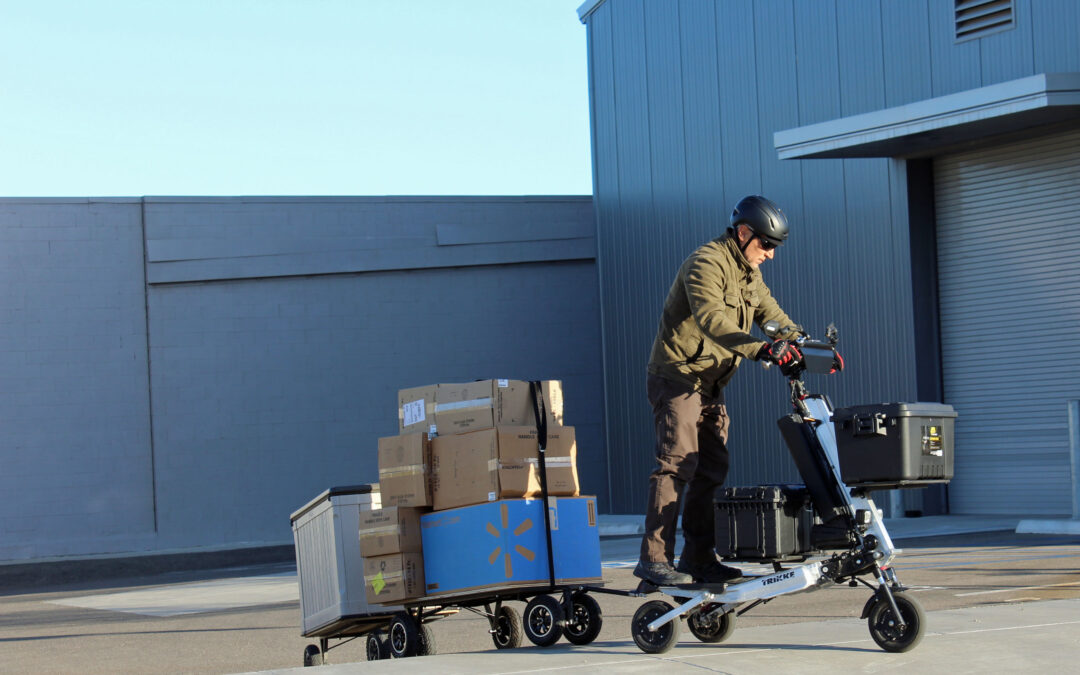
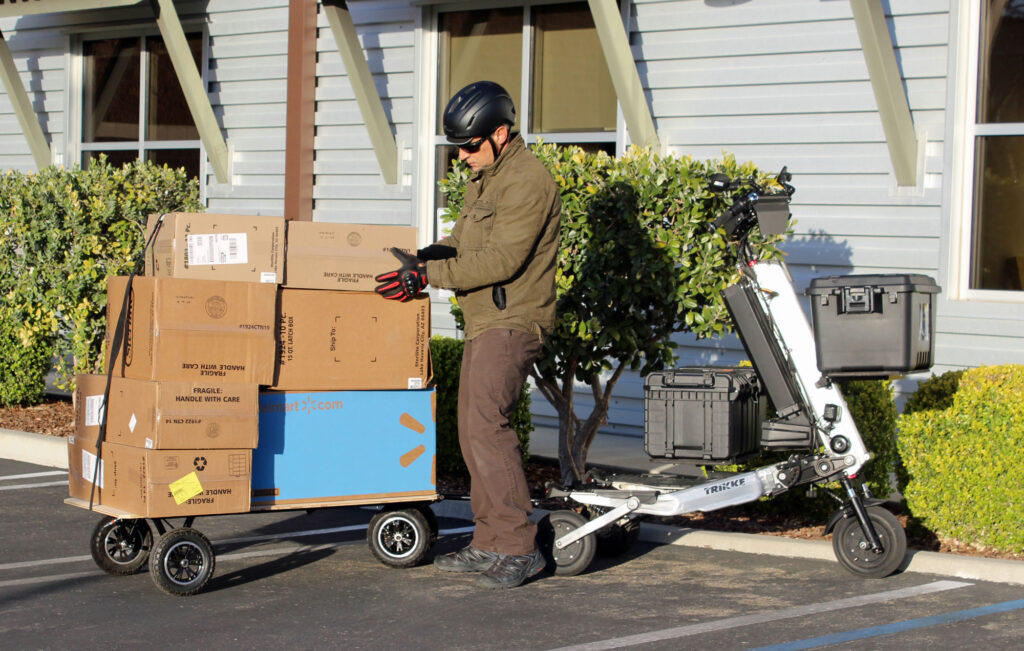
While the three-wheel, battery-powered Trikke is already suitable for many professional applications – including security and law enforcement, emergency services, and business logistics – the cargo system makes the Trikke an even more useful tool for those professions and many more. The key, says Beleski, is modulation:
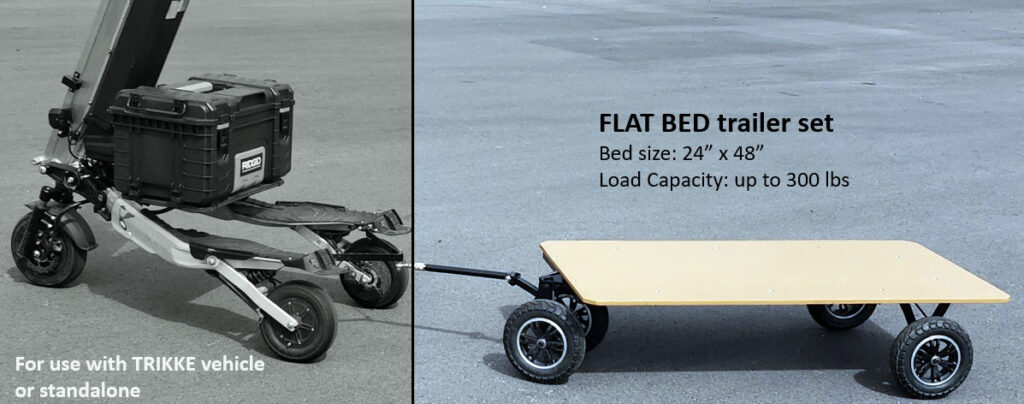
“Cargo boxes can be added and removed from the Trikke’s mainframe in seconds without leaving a trace. Plus, a trailer can be attached, then quickly disconnected and used as a standalone cart.”
The trailer itself can be a flatbed or a container model, allowing for a multitude of cart configurations that meet specific needs, such as transporting refrigerated items, hot food, or rescue equipment and medical supplies. (The flatbed model is also available via GSA Advantage.)
“A trailer that can be used as a standalone cart seems to be a better solution over building the cargo feature into the vehicle’s body,” says Beleski. “This way, for example, one vehicle can move multiple carts to the loading and unloading areas. Or a rider can disconnect from the Trikke and pull the trailer from door-to-door or even indoors.”
Modular mobility can make a big difference on so many levels, says Beleski, who’s been fine-tuning the Trikke’s specs and its many applications for decades:
“Our cargo system accomplishes the last mile delivery task more efficiently than trucks and vans. No idling, no noise or emissions, and very low footprint. Picture a cargo-carrying Trikke driving straight to the pick-up or delivery door instead of double-parking (or parking far away). This represents a key advantage: agility.”
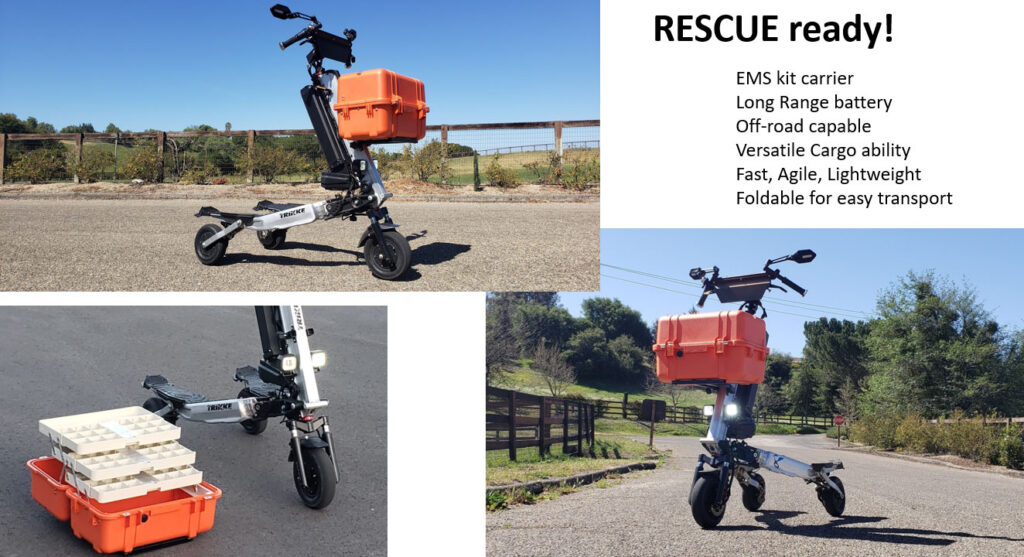
That agility isn’t just for the last mile delivery, either. Imagine Emergency Medical Services outfitted with an electric Trikke equipped with lifesaving cargo, neatly secured in a Pelican 1460EMS case, specifically designed in conjunction with fire departments and EMS personnel (and something Trikke Tech can install before shipping).
“Trikke vehicles can transport people and cargo efficiently,” says Beleski. “The Trikke Cargo System is smart, modular, and can be extremely competitive when compared to cargo bikes. We believe that Trikke, with its unique solution, is well-positioned for the last mile and beyond.”
To make the Trikke Cargo System work for you, contact our sales department or call us at (805) 693-0800.
Personal electric vehicles: ready for police tasks when a typical police car is not the best option.
Police Trikkes are turning heads and having a positive impact on the community of Wheeling, West Virginia, according to several local media stories.
Currently, two Trikke Positron are roaming the metropolitan area bordering the Ohio River and the foothills of the Appalachian Mountains, thanks to an anonymous donor.
“Immediately upon trying them, we thought they were really cool,” says Lt. Josh Sanders of the Wheeling Police Department in a story on the Intelligencer/Wheeling News-Register website. According to the article, the anonymous donor loved the idea of police Trikkes as much as the officers themselves.
“It’s just another tool in the tool belt,” says Sgt. Rob Safreed in the same article. “They’re very fun to ride, and I think it’ll be a really good tool for community outreach. You’ll be able to get out there in the community more, and people see you more. Plus, they can really extend the range of a typical foot patrol.”
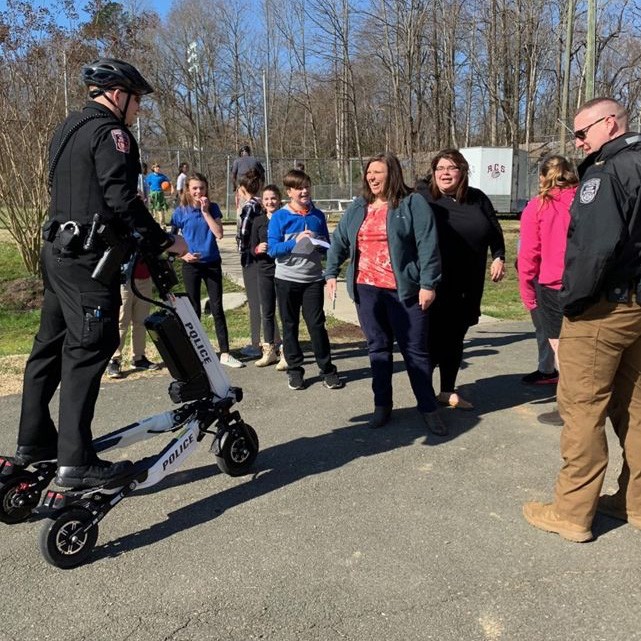
Also in the article, Officer Sanders talks about the impact the Trikkes have already had. “Everybody wants to know what they are. So community engagement is almost instant by just having the ability to stop, have a conversation and have a positive interaction.”
Meanwhile, in a WTRF-TV story about the department’s “fresh new ride,” the same officer Sanders says of the Trikkes: “They’re silent, they can sneak up on folks. They’re fast. It does not take a whole lot of effort like it would a bicycle or foot patrol.”
The Trikkes have already been deployed at several festivals in the area — including the Fourth of July Festival, the Italian Festival, and Waterfront Wednesdays — and the department plans to use them at future local events.
“Usually we’re on foot — but this will give us a quicker response during festivals and those types of larger gatherings,” says Sanders in the Intelligencer story.
Beyond that, he adds in a WTOV news story, the Trikkes can also be helpful in situations that call for special operations.
“Where are the hot spots? Where is there trouble, what type of trouble is that? As part of that operation, we may deploy vehicles like these,” says Sanders. The special operations commander also sings the Trikke’s praises on the Wheeling Police Department Facebook page:
“Already, several residents have seen the positive impact these new Trikkes are having in their area, by just having the ability to stop, have a conversation and have a positive interaction. Being able to make this addition to the Wheeling PD, with a heartfelt thanks to our anonymous donor, will no doubt increase our visibility, response time and enhance our continued efforts on community policing.”
The department also tells its Facebook followers that the Trikkes are personal electric vehicles ready for police tasks when a typical police car is not the best option.
Photos of the Wheeling, West Virginia Police Department Police Trikkes
How America’s cops are embracing this revolutionary electric vehicle.
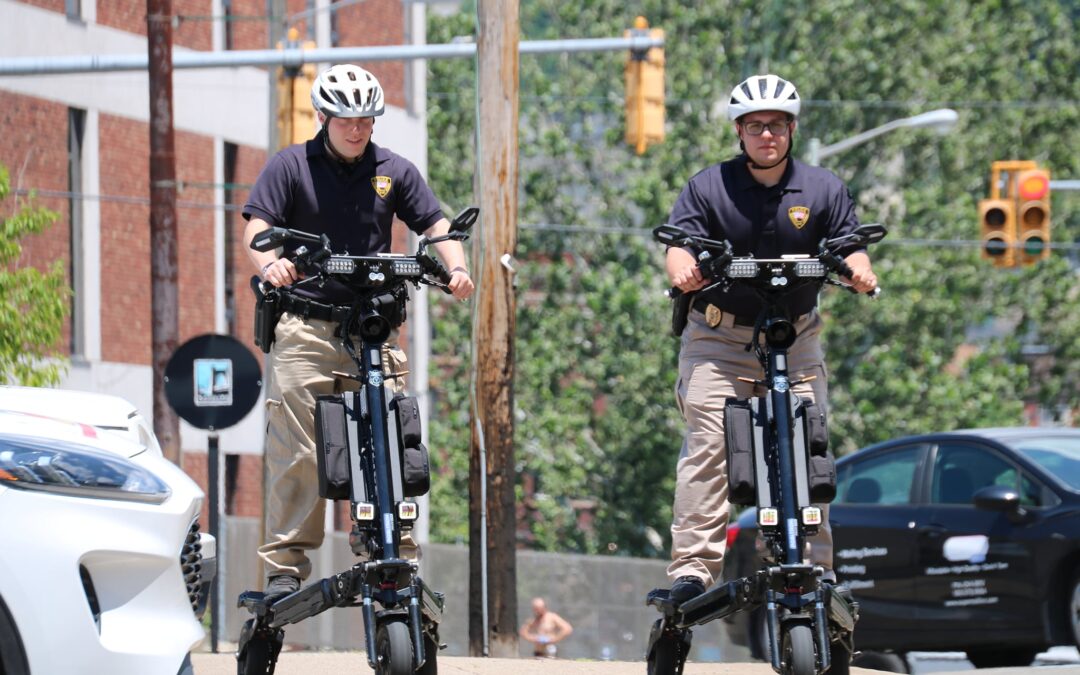
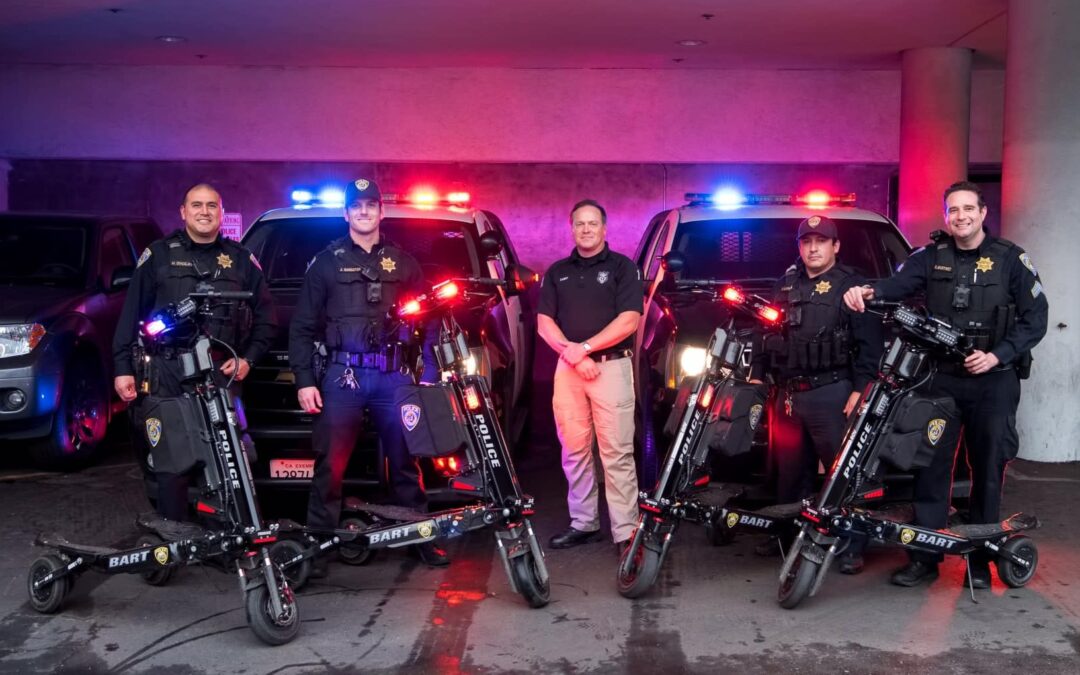
The Segway is a thing of the past, an artifact of less modern times. In its place, the Trikke Positron is steadfastly becoming the personal electric vehicle of choice for law enforcement officials — from California’s Bay Area Rapid Transit Police, to the Wilmington Police Department in Wilmington, Delaware.
Not only is the three-wheel, battery-powered Positron a great replacement for the lumbering curiosity that was the Segway, “police Trikkes” are proving to be a great multi-purpose tool in their own right, assisting officers in ways the old Segway could’ve only dreamed of.
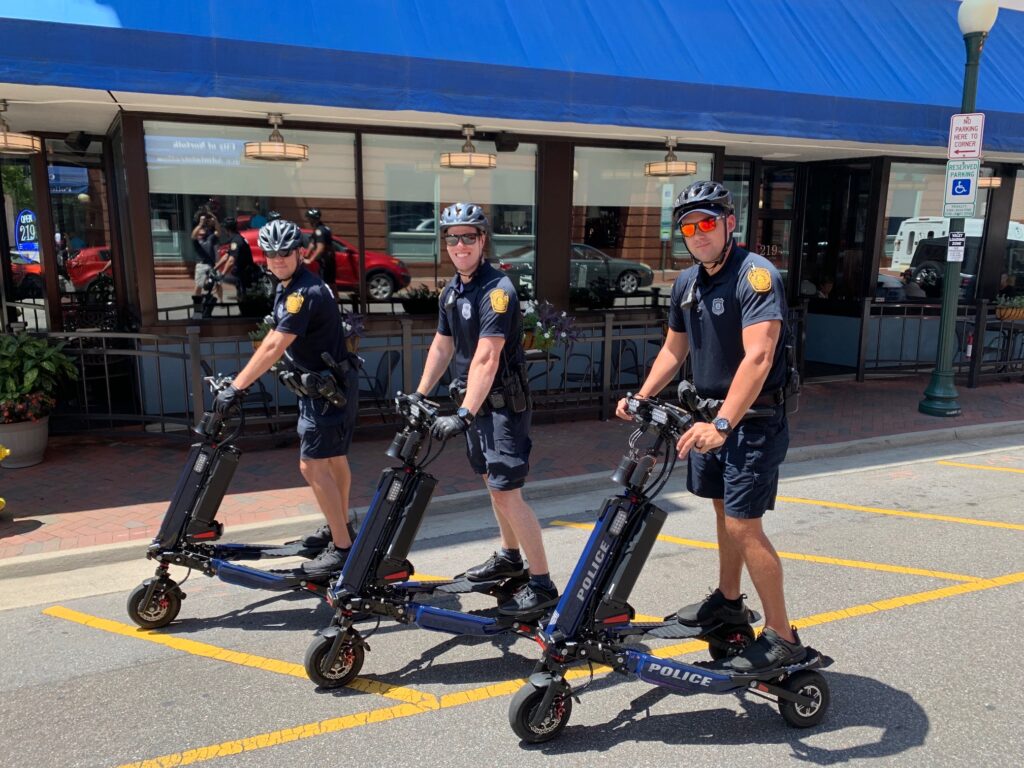
“There’s no comparison to the other options currently on the market; the Trikkes are miles ahead,” says Officer Mitchel Ashton of the Norfolk PD in Norfolk, Virginia.
It’s a popular sentiment among officers who’ve experienced riding the Positron, built expressly for law enforcement by Trikke Tech, Inc., through its Trikke Professional Mobility division.
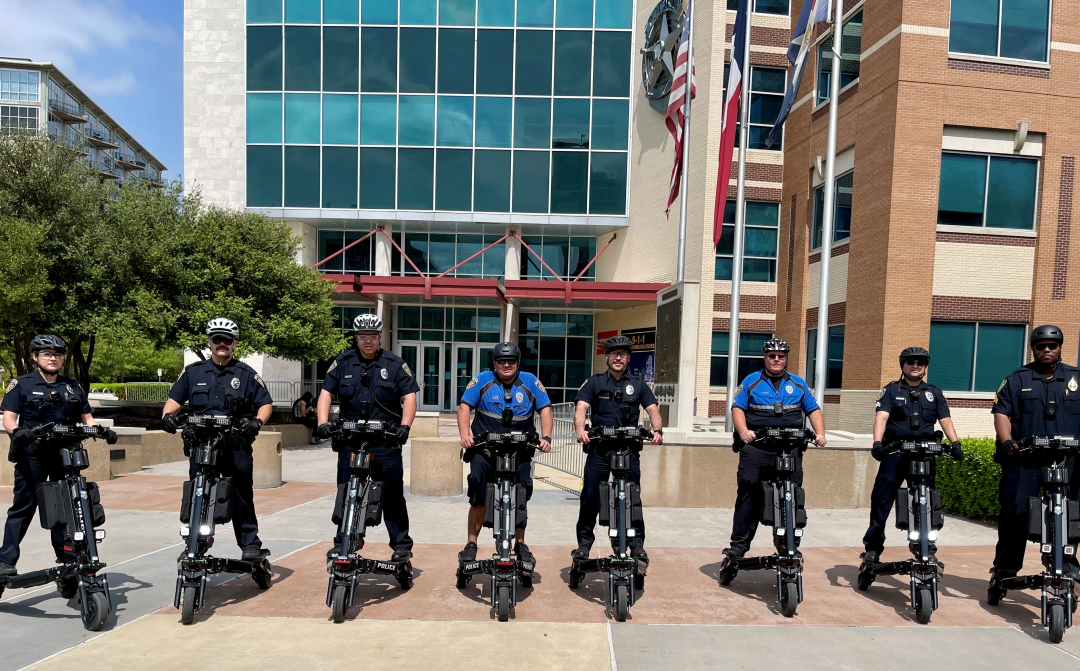
“All of my coworkers and the public love the Trikkes,” says Norfolk PD officer Mitchel Ashton (center).
Once makers of the body-powered Trikke carving scooter for consumers, Trikke Tech has evolved to become the U.S.-based manufacturer and distributor of rugged, professional-grade, personal electric patrol vehicles — mainly through word of mouth and the appearance of police Trikkes at many a law enforcement trade show.
Turns out, the cambering technology behind the original Trikke, plus the power of an electric battery have turned what was once a recreational alternative to the bike into a revolutionary new mobility solution for police officers on patrol.
“The proprietary, three-wheel cambering system is perfect for efficiently moving around congested areas, public events, and large campuses,” says Gildo Beleski, Trikke Tech’s CEO and chief engineer. “Trikke Positrons are quiet and highly-ergonomic, with high-torque electric motors, heavy-duty construction, and a small footprint, all technologies we’ve developed for law enforcement applications.”
Whether on patrol with the police departments of Atlantic Beach, Florida, Wheeling, West Virginia, or Royal Oak, Michigan, the Positron is an all-weather, multi-terrain vehicle designed for use in a variety of conditions, both indoors and outdoors, says Beleski.
“They can be parked close to any entrance,” he notes, “and their height makes them far superior to bikes in terms of visibility, especially when it comes to looking over traffic, parked cars, fences, and crowds.”
But don’t just take the word of the company’s CEO and inventor of the Trikke. Consider the rave reviews offered by actual police officers, especially for the Positron’s maneuverability.
“I really enjoy using the Positron,” says Lieutenant Brendon Barth of the Atlanta PD’s Video Integration Center. “It has great mobility, speed, handling and visibility. I’m able to ride on the street and go places cars can’t go. It’s perfect around parks and crowds.”
The Trikke Positron is a head-turner and people magnet.
Another unique featuring often cited: the Positron’s ability to promote positive interaction within the communities officers serve and protect.
“Police also say the Trikkes will make them more visible to the campus community,” notes a story by Dallas’ NewsRadio 1080 KRLD. In it, Dallas College Chief of Police Lauretta Hill echoes the idea that Positrons are a public relations plus: “Officers can get around, and people will walk up to us just because they want to know what it is.”
Turns heads. Promotes positive interaction. Provides a more mobile alternative to the extinct Segway. When’s the last time a police department acquisition did all that?
For this Texas-size community college system, electric Trikkes are “ideal for patrolling.”
How do you keep over 100,000 students on seven campuses safe? For the Dallas College Police Department, part of the solution is the Trikke Positron, the top-of-the-line, three-wheel, personal electric vehicle made by Trikke Tech and built expressly for law enforcement.
To aid in patrolling one of the largest community college systems in the Lone Star State, the department added the Positron to its lineup of security vehicles, mainly to help officers move around campus more quickly, according to an article on NewsRadio 1080 KRLD. In it, Dallas College officers speak highly of their new tool and its “new technology.”
“It’s really silent, so we can get around the campus without causing too much of a disruption to campus. We’ll also be able to patrol outside of campus,” says Officer Luis Leal in the article.
Additionally, Chief of Police Lauretta Hill comments on how the Trikkes make officers more visible to the campus community: “Officers can get around, and people will walk up to us just because they want to know what it is,” she notes in the article.
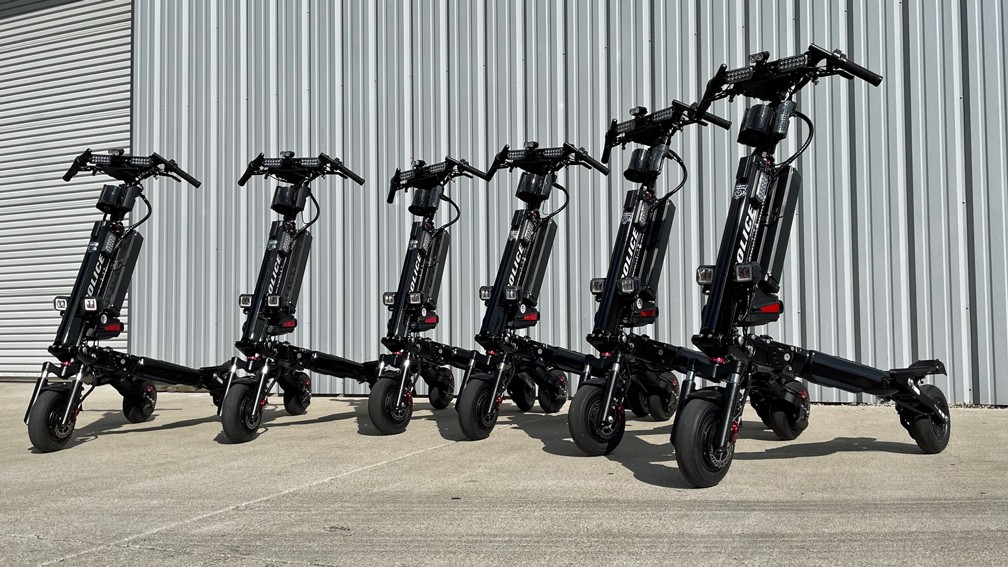
The Dallas College Police Department’s fleet of Trikke Positrons are built expressly for law enforcement.
After starting in November 2019 with four Positrons, the department — seeing their benefit — just added six additional units to cover more of the school’s campuses.
To help spread the word about their new patrol vehicles, Dallas College posted a video on its Facebook page introducing the three-wheelers to its community.
“Can your car or bicycle use an elevator?” the video asks while an officer on a Trikke easily rides off an elevator, then down a hallway. The thirty-second clip also features both voice-over and graphics highlighting how Positrons are “ideal for patrolling campuses and keeping them safe,” and how they can “quickly gain access inside buildings and tight areas.”
But perhaps most notably, Dallas College via its video declares: “we are proud for our police to be among the first in the state to use this tool.”
Go here to find out more about the Trikke Positron. Go here to schedule a demo of the Trikke Positron for your law enforcement agency. Go here to learn more about all of Trikke Tech’s professional mobility options.
More speed, less noise, more cool: “Trikkes are an excellent replacement.”
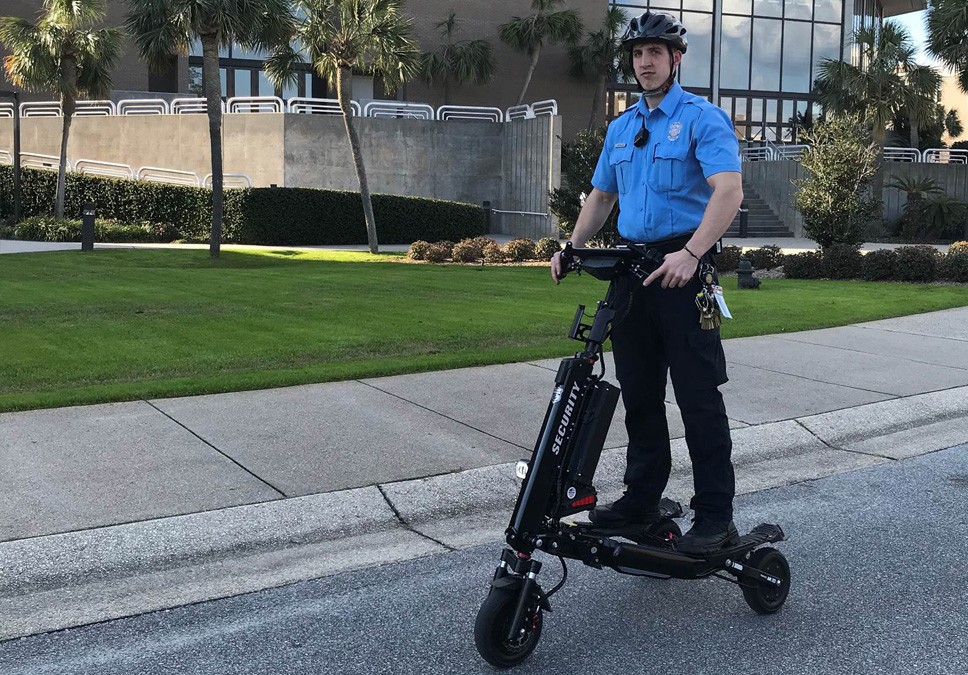
For years, security officers at Pensacola Christian College relied on Segways to patrol the private Christian school nestled in the westernmost city on the Florida panhandle. But with the closure of Segway’s Personal Transport division, a new solution was needed. Enter the Trikke Defender, part of Trikke Tech’s lineup of personal electric vehicles built expressly for security and law enforcement purposes.
So how’s that working out so far?
“The Trikke Defender has stepped in as an excellent replacement,” says Ben Justus, security supervisor for PCC. “It has significantly more speed than a Segway, which has improved our mobility.”
Justus also notes that while the new vehicles do present a professional image, the students also think they look cool.
Let’s face it: authority figures looking cool is always a bonus. So, too, is the fact that the officers like patrolling on the three-wheel, cambering Defenders:
“Learning to ride is a little more nuanced than a Segway because of the throttle and brakes,” says Justus, “but all the officers have picked up on it fast and enjoy riding them.”
That adds up to Trikke Defenders being a suitable and durable replacement, according to Justus. As far as its best features, the security supervisor cites the speed, the removable batteries, the pre-configured light package, and the fact that Trikkes are quieter than Segways.
“Mr. Beleski has put a lot of good engineering into the product, so I can’t think of anything that I would change,” says Justus, speaking of Trikke Tech CEO and Chief Engineer Gildo Beleski. “Overall, it is a good product and better than Segway.”

Recent Comments