Snapshots from a patrol movement as it expands across regions and environments
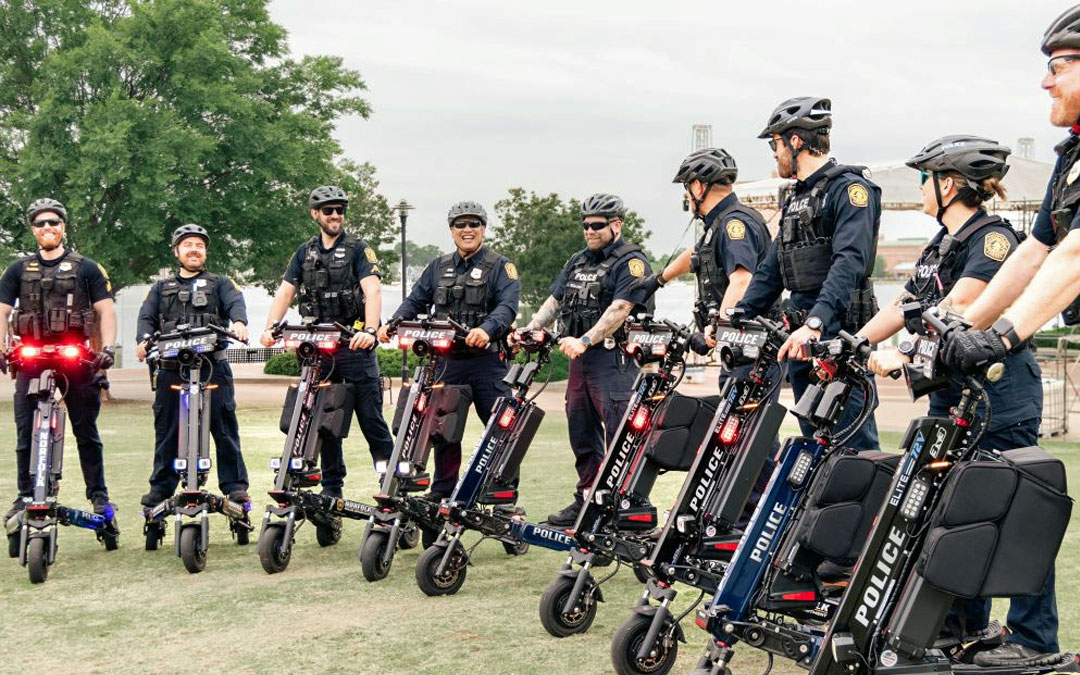
2025 marked another period of steady growth and visible expansion in the Trikke patrol movement. Across a wide range of environments — from convention centers and downtown corridors to airports, hospitals, race events, and municipal campuses — police departments, security teams, and public agencies continued to adopt Trikke patrol vehicles as part of their daily operations. The stories below capture key moments from the year, showing how and where agencies put Trikke mobility to work as the movement continued to take shape.
At the Birmingham–Jefferson Convention Complex in Alabama, security teams introduced Trikke patrol vehicles to strengthen visibility across large indoor and outdoor event spaces. The mobility upgrade helped staff move efficiently through heavy visitor traffic, addressing the needs of one of the state’s busiest venues.
Somerton Police in southern Arizona expanded their mobility capabilities with 60v Trikke Positrons, noting improved officer endurance and stronger community engagement during routine patrols. Plus: see our in-depth Somerton PD case study.
INDYCAR security operations at the Indianapolis Motor Speedway incorporated Trikke Positrons to maneuver efficiently through crowds and around restricted areas during major race events. The vehicles supported event staff across one of the most high-traffic sporting environments in the country. Plus: see our in‑depth INDYCAR case study.
This story shares officers’ comments after riding the Positron, noting reduced fatigue, increased visibility, and improved public interaction. The result: a straightforward look at how patrol units describe their experience using the vehicles.
In downtown Fargo, North Dakota, officers adopted Trikke patrol vehicles to improve mobility across busy pedestrian areas and enhance overall visibility. The deployment showcased how Positrons can support urban patrol strategies in compact, high-activity districts. Plus: see our in‑depth Fargo PD case study.
The Seattle emergency response team added Trikke Positrons to navigate waterfront parks and crowded public areas. The vehicles provided quick access through terrain where traditional vehicles are limited, strengthening on-the-ground mobility for the team.
In Cataño — located just across the bay from San Juan — municipal police added Trikke patrol vehicles as part of Puerto Rico’s expanding network of agencies using Positrons. Officers used the vehicles to increase visibility in waterfront areas and community-focused corridors.
In Warren, a major city in suburban Detroit, police adopted Trikke patrol vehicles to strengthen coverage in parks, business districts, and public-facing areas. Officers reported improved mobility and an elevated presence during routine patrols.
At the VA medical campus in New Orleans, officers incorporated Trikke patrol vehicles to move efficiently across large, multi-building grounds. The vehicles supported rapid circulation between patient areas, administrative zones, and parking facilities.
In Southern California, Hollywood Burbank Airport introduced Trikke patrol vehicles to help officers navigate terminals, parking structures, and arrival areas. The training footage highlighted how the airport’s police force integrated Positrons into their daily operational workflow.
⸻
Looking ahead: The Trikke patrol movement grows in 2026
If 2025 demonstrated anything, it’s that mobility is changing — and agencies adopting Trikke patrol vehicles are leading the shift. More departments are reporting improved ground coverage, stronger visibility, and a more engaged presence with the communities they serve. Dozens of additional agencies have requested demos and pilot evaluations, with new deployments expected across law enforcement, private security, aviation, higher education, municipal services, and healthcare facilities.
Stay tuned to the Trikke Mobility Chronicle throughout 2026 as the movement continues to accelerate — and as more agencies across the country join in.
A modern mobility upgrade for those who serve our nation’s veterans.
The U.S. Department of Veterans Affairs Police Department in New Orleans has added the 60-volt Trikke Positron to its mobility fleet — a forward-thinking move that reflects the agency’s ongoing commitment to high-quality service on VA campuses.
Responsible for protecting patients, visitors, staff, and property across the national VA healthcare network, the VA Police are a full federal law-enforcement agency. Their duties include patrol operations, emergency response, investigations, disaster readiness, and ensuring a secure environment for the nation’s veterans receiving care. With large campuses, high-traffic facilities, and long-duration patrol needs, the New Orleans team now has a tool designed to help officers cover more ground with less fatigue.
The Trikke Positron gives officers an elevated, highly visible patrol presence and the ability to maneuver quickly through hospital grounds, parking areas, and pedestrian-heavy zones — without the limitations of foot patrol or traditional vehicle access points. It’s a natural fit for medical campuses where responsiveness and approachability go hand-in-hand.
VA departments around the country have increasingly shown interest in modern patrol mobility. Agencies now deploying Positrons include VA Police units in Cheyenne, Wyoming; Durham, North Carolina; and within the VA Caribbean Healthcare System in Puerto Rico.
The addition of New Orleans VA Police continues that momentum, demonstrating how agencies are upgrading their mobility tools to meet the expectations of today’s public-facing patrol environments.
Trikke Professional Mobility is honored to support the mission of those who serve America’s veterans, and we look forward to seeing the Positron in action across the New Orleans VA campus.
Photo courtesy of the U.S. Department of Veterans Affairs Police Department, New Orleans.
The department purchased four Positron 72V XL units using leftover COVID-19 relief funds, meaning no local tax dollars were used—a point several outlets highlighted. The goal was simple: give officers a fast, versatile patrol option for large events and neighborhoods where cars or bikes don’t fit the job.
“In a large city like Warren, foot and bicycle patrols just aren’t practical,” said Lt. John Gajewski, the department’s public information officer, in an interview with WXYZ-TV. “We’re not Royal Oak, we’re not Ferndale or Birmingham where you could argue a couple of officers walking the beat would make sense.”
Instead, Gajewski said, the new Trikkes allow officers to move quickly through parks, business districts, and major community events—from Halloween patrols to football games and city fairs.
“It’s a pretty cool tool,” he told WXYZ. “People see this, they’re going to pause, they’re going to come up and talk to the officer, and it is a great operational tool.”
That sense of approachability is something Warren PD wanted to emphasize. With the Positron’s elevated stance and quiet electric operation, officers can engage with residents more easily—and remain visible in crowds.
Commissioner Eric Hawkins called the addition “a game-changer for our department,” according to the official city release.
Each unit is all-wheel drive with a top speed of around 37 mph and a 30-mile range per charge—built to handle extended shifts at large events. The department expects to deploy them year-round for parades, festivals, and special assignments requiring both speed and face-to-face visibility.
Residents have already responded positively. “Good way for crowd control,” one local told WXYZ. Another added that they hoped to see one on their street soon.
“I think it’s one of those things that after we’ve had it awhile, we’re going to ask ourselves why we didn’t get them sooner,” said Gajewski.
For Trikke Professional Mobility, it’s another example of how departments are not only improving their patrol strategies but also gaining public recognition for it. Each new deployment doesn’t just put officers on Trikkes—it puts agencies in the spotlight, showcasing innovation and community connection in action.
⸻
See more real-world examples of departments deploying Trikkes in our Case Studies library.
Three-wheel electric vehicles and cargo system deliver agile mobility for amusement parks, resorts, and large venues.
Trikke Professional Mobility will exhibit its latest fleet solutions for security and logistics at the 2025 International Association of Amusement Parks and Attractions (IAAPA) Expo, taking place November 18–21 at the Orange County Convention Center in Orlando, Florida (Booth #7210, Outdoor Exhibits).
The spotlight will be on the Trikke Positron—redefining mobility in resorts, theme parks, universities, campuses, and large venues—and the complementary Trikke Cargo System, which enables onsite teams to move equipment, supplies, and deliveries around large properties efficiently with zero emissions.
“Mobility is mission-critical in environments where every moment counts,” said Gildo Beleski, CEO of Trikke. “Our three-wheel vehicles allow security and operations teams to be more visible, more agile, and more service-oriented—while the cargo-capable model brings a new dimension of utility for venues that need lightweight logistics across site.”
Key Benefits:
• Faster coverage of large areas with fewer personnel
• Elevated presence that supports guest engagement and responsiveness
• Quiet, electric mobility with zero emissions—ideal for resort, campus, and entertainment settings
• Modular cargo platform for on-site transport and delivery
• Simple operation and rapid deployment for indoor and outdoor environments
Trikke will present live displays of the vehicles at Booth #7210 (Outdoor Exhibits), offering show attendees an up-close look at each model’s design, features, and modular options. The company’s promotional video (at the top of the page) also complements the exhibit as an added resource for attendees and prospective clients.
Positron electric patrol vehicles boost officer mobility, visibility, and community engagement across the island.
The Cataño Police Department in Puerto Rico has officially joined the Trikke patrol movement, deploying the all-electric Positron to enhance local patrol operations. Located just across the bay from San Juan, the small but active coastal city of Cataño faces unique patrol challenges—from crowded waterfront areas to narrow streets—making agility and officer visibility essential.
Training for the department’s new Positron fleet was led by Albert Rivera, Certified Patrol Trainer and Sales Executive for Trikke Professional Mobility, who has spent more than a decade helping police agencies across Puerto Rico and Latin America integrate electric patrol mobility into their operations.
“Trikke has successfully established a strong presence in Puerto Rico with law enforcement and public-safety operations across the island,” Rivera said. “The Positron has proven to be reliable, efficient, and environmentally friendly, helping police departments and security agencies improve mobility while reducing fuel costs and emissions.”
Already deployed in over a dozen municipalities and security agencies—including major departments such as San Juan, Isabela, and Humacao—the Positron has become a familiar sight across the island. Each new deployment adds to what Rivera calls “a wave of modernization” in community policing.
“Over the past 10 years, we’ve partnered with several municipalities and government agencies to integrate electric Trikkes into their patrol and community programs,” he said. “The feedback from officers and local officials is been overwhelmingly positive, highlighting the rapid response and surveillance detail only the Positron can provide.”
The first impressions in Cataño have been strong. Just days after their initial deployment, the department request a quote for three additional units—a clear sign of satisfaction and early success.
That kind of response isn’t unusual. Across the U.S. and the Caribbean, Trikke customers frequently come back for more, with a remarkable rate of re-orders from departments that see the results firsthand.
When agencies reinvest, it’s proof that the product performs in the field: reducing officer fatigue, expanding coverage, and improving community interaction—all while cutting operating costs.
“I am very proud to be part of the Trikke team since 2009,” Rivera added, “and to have the privilege of training law enforcement agencies in the Positron’s operation. Seeing the positive impact these vehicles bring to officers and communities makes every deployment meaningful.”
With departments like Cataño leading the way, Puerto Rico continues to stand out as one of Trikke’s strongest territories for law enforcement adoption. From coastal towns to international airports, agencies across the island are proving what’s possible when mobility meets innovation.
⸻
See how other agencies are redefining patrol mobility. Explore case studies featuring real stories from the field.
• 📈 Tactical insightsinto visibility, mobility, and modern patrol strategy
Every post is part of the bigger picture: how agencies are moving smarter, covering more ground, and staying connected with the communities they serve.
Real agencies. Proven results. Stories that matter.



Recent Comments