The Positron 60V bridges the gap between foot patrol and larger patrol vehicles, helping officers cover more ground while remaining connected to the community.
Parks. Trails. Downtown streets. Community events.
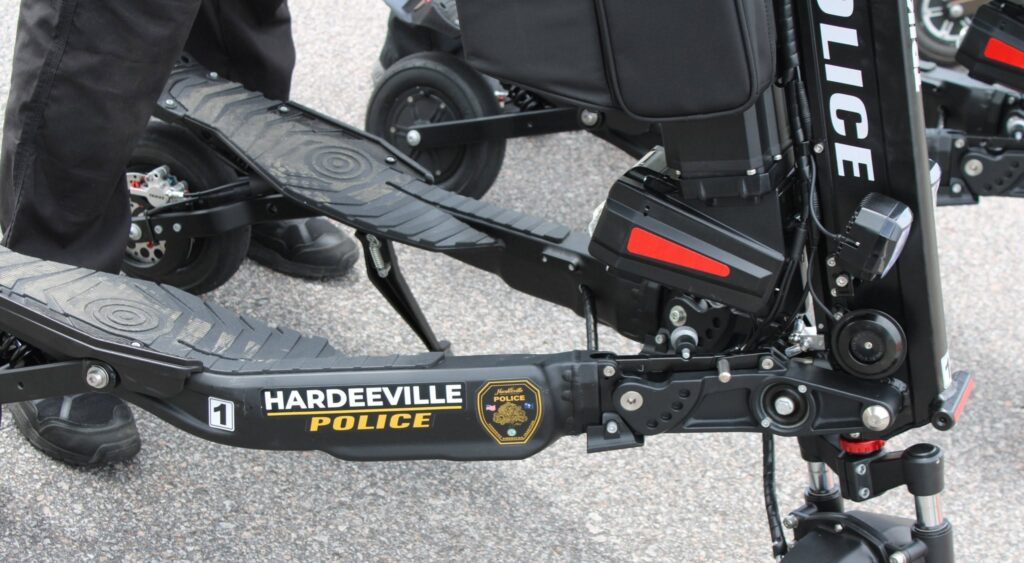
Those are the environments where officers from the Hardeeville Police Department expect to put their new Trikke patrol vehicles to work as part of the department’s ongoing commitment to community-oriented policing and public safety.
The department recently added two Trikke Positron 60V patrol vehicles to its fleet, becoming the first law enforcement agency in the Palmetto State to deploy Trikke Professional Mobility vehicles.
In announcing the new patrol vehicles, the department highlighted their ability to help officers remain highly visible and approachable while moving efficiently through areas where traditional patrol vehicles can be less practical.
According to the department, the Trikkes will be used to patrol parks, trails, downtown areas, special events, and community gatherings. The vehicles provide greater mobility than foot patrol while helping officers maintain a strong presence and increase positive interactions with residents and visitors.
For agencies focused on community engagement, visibility matters. Officers who can move easily through public spaces while remaining accessible to the people they serve are often better positioned to build relationships, answer questions, and address issues before they escalate.
The Trikke Positron 60V helps bridge the gap between foot patrol and larger patrol vehicles. Its compact design allows officers to navigate crowded areas and community spaces while covering more ground than they could on foot alone.
As communities continue to grow and public events become larger and more frequent, agencies across the country are looking for ways to increase patrol coverage without sacrificing visibility or approachability. Hardeeville’s deployment reflects that trend.
By becoming the first law enforcement agency in South Carolina to adopt Trikke patrol vehicles, Hardeeville Police is embracing a patrol strategy focused on mobility, presence, and community connection.
Photos courtesy of the Hardeeville Police Department.
What happens after Trikke patrol vehicles move beyond the novelty stage?
Several stories from the Trikke Mobility archives reveal a pattern familiar to almost any new technology.
First comes curiosity.
Then comes experience.
Then comes the moment people stop talking about what something is.
And start talking about what it does.
When Atlanta Police Chief Rodney Bryant was introduced to Trikke patrol vehicles in 2022, his reaction was one many people can understand:
“I never would have thought in a million years that something like this would be equipment on our streets.”
At the time, the conversation centered on possibilities. Could these three-wheel, electric vehicles help officers manage crowds, navigate traffic, and improve visibility in busy public spaces? Atlanta wasn’t alone. Around the country, departments were introducing Trikke patrol vehicles to their communities and local media, often generating the same mix of curiosity and excitement.
In Indianapolis, deputies described their new patrol vehicles as:
“Agile electric horses without the cleanup.”
In Wheeling, West Virginia, local media followed officers as they introduced the vehicles to the community. In Fargo, North Dakota, and Somerton, Arizona, departments explained how patrol mobility might help improve coverage, visibility, and public engagement.
At that stage, the discussion was largely about potential.
What could these vehicles do?
How would officers use them?
Would they prove effective in the field?
Several years later, many of those questions have been answered by the officers who ride them.
In a 2025 roundup of law enforcement comments from across the country, the conversation sounded noticeably different.
Wheeling Police Lieutenant Josh Sanders observed:
“Immediately upon trying them, we thought they were really cool. Community engagement is almost instant.”
Dallas College Police Captain James Smith Jr. focused on operational benefits:
“With a Trikke, you’re just cruising right through the environment and covering a lot more area with a lot less energy.”
And in Atlanta, where the story began with curiosity, Lieutenant Brendon Barth offered a much simpler assessment:
“I really enjoy using the Positron. It has great mobility, speed, handling, and visibility. It’s perfect around parks and crowds.”
The contrast is revealing.
The early stories are about introduction.
The later stories are about experience.
Together, they show how perceptions evolve once a new patrol tool moves from the novelty stage to everyday use.
From police departments to airport security, real-world users quickly adapt to the Trikke Positron platform with hands-on instruction and real-world experience.
When agencies evaluate patrol mobility platforms, one question always rises quickly to the surface:
How long does it take officers to become comfortable using it in the real world?
The answer throughout Trikke’s latest training video is remarkably consistent: confidence develops quickly once riders spend time on the platform:
“Training starts with confidence. From first ride to full control, the Trikke Positron is designed to feel intuitive from day one.”
The video combines feedback from real-world patrol deployments, security operations, and hands-on training experiences across multiple environments.
One of the strongest examples of how quickly riders adapt to the platform comes from Mike Bates, senior director of safety and security for IndyCar racing.
“Took a little bit to get used to, but I would say it feels so natural now,” Bates says. “And it sounds crazy, but it almost feels like part of your body. The way it moves, you move with it.”
For large-scale event security operations, mobility and rapid response matter.
“And just the ability to get somewhere quickly,” Bates adds. “That’s really important for us in security.”
The training itself focuses on both riding fundamentals and operational understanding of the platform.
“On the tech side, it’s educational understanding the vehicle, how simple it is,” says Trikke CEO Gildo Beleski. “They see how things are connected — the wires and the motors and battery and everything. It makes it easy for them to maintain the vehicle and operate because now they understand.”
That hands-on approach continues during Trikke’s Tech & Ride training events held each spring and fall at company headquarters in Buellton, California. Riders not only work on handling, braking, balance, and maneuverability, but also learn more about the vehicle itself, including maintenance, operation, and the technology behind the platform.
“It was very natural getting on it,” notes Chris Cabral of Burbank Airport PD in the video. “Just getting used to the body lean and everything else, but standing upright and the threshold braking and then being able to turn tight. I got pretty comfortable with it very quickly.”
Even experienced departments continue discovering new capabilities during training sessions. As Beleski notes:
“Officers that are using basically every day, they came to the training and they were raving that wow, I didn’t know you can do this…”
That operational familiarity can have a major impact on long-term adoption inside departments, even among agencies already actively deploying the platform.
The video also features Brian Mahone, director of safety and security for IndyCar racing.
“Once you get on it, it responds to your natural body weight, your natural movements,” Mahone says. “They’re awesome. They’re awesome.”
For agencies concerned about rider adoption and operational readiness, the feedback remains consistent across environments ranging from major racing events to airport patrol operations.
“At the end, they will say, ‘This is easy,’” Beleski adds.
And perhaps the biggest takeaway from the training experience is how quickly rider confidence evolves once officers spend real time on the platform.
“After three days of training,” Beleski says, “they come back say, ‘Wow, I’m much better rider now.’”
For departments focused on visibility, mobility, and operational efficiency, that combination of confidence, control, and real-world adaptability continues to make an impression across the patrol and security world.
Metro officers on Trikke vehicles accompany report showing crime down despite population growth
A Houston Chronicle report on the city’s Midtown area highlights a notable trend: crime in the neighborhood has reportedly dropped 23% since 2019 even as the population has grown roughly 40%.
Accompanying the article is a photo of Houston-area Metro police officers patrolling Midtown on Trikke vehicles, a visible reminder that modern patrol strategies are increasingly focused on mobility, presence, and community engagement in dense urban environments.
Currently, the Houston PD deploys 6 Positron 60V AWD on its force.
Trikke Positron vehicles support security teams across one of motorsports’ biggest stages
When IndyCar returned to the Acura Grand Prix of Long Beach in April, Trikke Professional Mobility was along for the ride, continuing a growing partnership that began during the 2024 season.
Now in 2026, that partnership continues across multiple events, including the upcoming Indianapolis 500, where speed, coordination, and mobility are critical behind the scenes.
At Long Beach, two new Positron Version 3 units were deployed as part of the ongoing partnership, supporting the IndyCar security team as they navigated one of the most complex event environments in motorsports.
Mobility that matches the moment
For Director of Safety and Security Brian Mahone, the value shows up immediately in the field.
“You’re elevated. You can see over the crowd. It gives us more visibility and lets us get places faster than walking,” he says. “We’re constantly moving between pit lane, the medical center, the media center, the paddock, and our trailer. Being able to do that quickly is huge.”
That constant movement defines race-day operations. Security teams are circulating, responding, and repositioning across large, crowded spaces where traditional vehicles can struggle.
That is where Trikke patrol movement fits naturally.
Built for large-scale event environments
At a venue like Long Beach, where tens of thousands of fans fill a multi-block footprint, mobility is about efficiency, access, and control.
Mike Bates, part of the IndyCar security team, puts it simply.
“Mobility is everything. These are nimble. You can move anywhere. Even in a crowd, you can still navigate easily.”
Compared to golf carts or gas-powered scooters, the Positron platform allows teams to move continuously without the same limitations in maneuverability or availability.
“It is not about going fast,” Bates says. “It is about getting from point A to point B.”
A natural extension of the operator
For trained personnel, many with law enforcement or motorcycle backgrounds, the learning curve is minimal.
After just a few events, the vehicles become second nature.
“It starts to feel like part of your body,” Bates says. “The way it moves, you move with it.”
That connection matters in high-demand environments where response time, awareness, and control all work together.
Visibility, validation, and scale
For Trikke Professional Mobility, the IndyCar partnership is about proving performance in one of the most demanding live event settings in the country.
“IndyCar is the pinnacle of motorsports in the U.S.,” says Gildo Beleski, CEO of Trikke Professional Mobility. “Being part of these events gives us exposure, but it also validates our technology alongside everything else you see here.”
In an environment filled with advanced systems, the simplicity and effectiveness of the platform stand out.
“It fits perfectly,” Beleski says. “You have people, vehicles, and equipment moving everywhere. The Trikke works naturally in that space.”
From Long Beach to Indianapolis
As the season continues, Trikke vehicles will remain part of the operational landscape at IndyCar events across the country.
From the streets of Long Beach to the brickyard of the Indianapolis 500, the goal is the same.
More visibility. More control. More ground covered.
Before agencies deploy new patrol equipment, they want proof—in real environments, with real officers, solving real problems.
That’s exactly what Trikke Professional Mobility’s social channels deliver every day.
Where patrol performance becomes visible
Across airports, downtown districts, campuses, and major events, Trikke Positron patrol vehicles are already in use.
On our social channels, you’ll see:
Officers navigating dense crowds with speed and control
Security teams covering large properties more efficiently
Real deployments at major venues and public events
First-hand reactions from officers and command staff
This is where “force multiplier” stops being a phrase—and becomes something you can actually watch in action.
Built for how agencies actually evaluate equipment
Trikke Mobility’s social content focuses on:
Real-world deployment footage
Officer feedback and reactions
Multi-environment use cases
Ongoing field performance
Because seeing consistent results builds confidence faster than any pitch.
More than visibility—it’s perspective
The patrol movement isn’t just about getting from point A to point B.
It’s about:
Increasing officer visibility
Improving response capability
Reducing fatigue over long shifts
Creating more approachable, community-facing patrols
And those benefits show up clearly when you see the vehicles in use.
Follow the field, not the feed
If you’re exploring new patrol solutions—or simply want to see how modern mobility is changing the way agencies operate—follow Trikke Professional Mobility:




Recent Comments